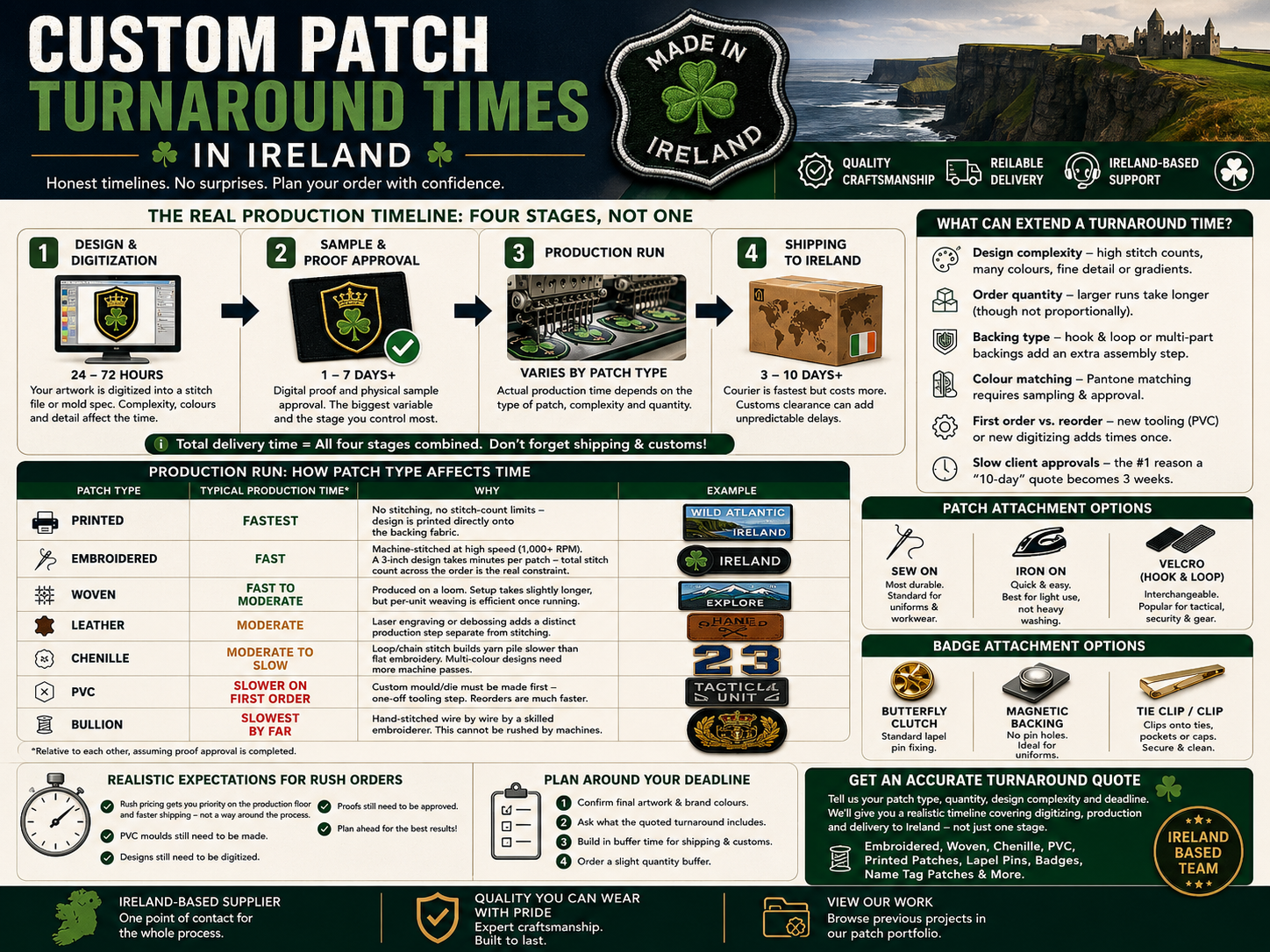
One of the first questions we receive at Patch Makers Ireland is, “How fast can you get these to us?” It’s a reasonable question, as many patch suppliers promote headline figures like “10-day turnaround” without providing an explanation of what that figure actually entails or what happens to it once a real design, a real quantity, and real shipping to Ireland are taken into account. In order to help you plan your order around your actual deadline rather than a marketing estimate, this article breaks down the process step by step and provides technical details on why certain patch types are actually faster to make than others.
Every “turnaround time” you come across online is actually a combination of four distinct steps, each of which has its own bottlenecks.
1. Design and digitization (usually takes 24 to 72 hours)
Your artwork must be transformed into a digitized stitch file—a machine-readable collection of instructions that describe stitch type, direction, density, and color sequence for an embroidery machine, or a mold specification for PVC—before a single stitch is stitched. For a simple design, this step is typically quoted at about 24 hours, but complexity matters: a logo with small text, gradients, fine detail, or more than 6–8 colors take a digitizer longer to translate cleanly because each color change and stitch direction must be manually planned to prevent the design from “filling in” or losing definition at production size.
2. Sample and proof approval (the single biggest variable)
Before committing to a complete run, almost all respectable manufacturers send a digital proof and a physical pre-production sample for bigger or color-critical orders. In addition to being the stage where you have the greatest control over speeding up or slowing down, this is the point where most reported turnaround times neatly begin to count. Regardless of how quickly the production floor operates, a week of internal sign-off adds a week to your delivery date; a same-day approval maintains your order on time. Budget additional time if your brand’s colors need to be Pantone-matched; the little wait will be worthwhile if the colors are approved on a real swatch rather than merely a screen mock-up.
3. Production run (this is where patch type genuinely matters)
This is where actual, non-marketing speed differences are produced by the technical variations between patch types:
Patch type | Typical production time | Why |
Fastest | No stitching, no stitch-count limits — design is printed directly onto the backing fabric | |
Fast | Machine-stitched at high speed (commercial heads run at roughly 1,000+ RPM); a typical 3-inch design with several thousand stitches takes only minutes of actual machine time per patch — the constraint is total stitch count across the full order, not per-piece complexity | |
Fast to moderate | Produced on a loom rather than stitched; setup takes slightly longer than embroidery but per-unit weaving is efficient once running | |
Moderate | Laser engraving or debossing adds a distinct production step separate from stitching | |
Moderate to slow | The chain-stitch/loop technique that builds the yarn pile runs slower per patch than flat embroidery, and complex multi-colour designs need more machine passes | |
Slower on first order | A custom mould or die has to be produced before any patches can be moulded — this tooling step is a one-off per design, so reorders of an existing PVC design are much faster than a first run | |
Bullion | Slowest by far | Genuinely hand-stitched, wire by wire, by a skilled embroiderer — see our bullion patches guide for why this can’t be sped up with machinery |
*In relation to one another, presuming proof approval has already been completed; the actual number of days depends on the complexity and amount of your particular order.
4. Shipping to Ireland
This is the stage most patch buyers underestimate, and it’s the one where “10-day turnaround” quotes most often fall apart in practice. Once patches are produced, they still need to physically reach you:
A layer of that uncertainty is eliminated when you work with an Ireland-based supplier who handles this procedure on your behalf. This is because you deal with a single point of contact for the whole trip instead of managing a manufacturer and a freight forwarder independently.
Beyond patch type, these are the factors that most commonly push a delivery date later than the headline number suggested:
For many patch kinds, especially embroidered, woven, and printed ones, fast manufacturing is truly feasible. However, it’s important to realize that a rush price just gets you priority on the production floor and accelerated shipment, not a circumvention of the actual physical process. Before the first piece is created, a PVC mold must be created and a design must still be scanned and approved. Contacting your supplier as soon as possible with your artwork and Pantone codes ready to go is the best course of action if your deadline is truly short, as opposed to asking for a hurry once the design and approval phases have already taken up time.
If you’re working backward from an event date, staff uniform rollout, or product launch:
Rather than working off a generic headline number, tell us your patch type, quantity, design complexity and deadline, and we’ll give you a realistic timeline covering digitizing, production and delivery to Ireland — not just the fastest stage of the process. We produce embroidered, woven, chenille, PVC, and printed patches, plus lapel pins and badges and name tag patches.
Request a free quote with your deadline and we’ll confirm what’s realistically achievable, or contact our Ireland-based team to talk through a time-sensitive order. Browse previous work in our patch portfolio.
Frequently Asked Questions
What is a reasonable turnaround time in Ireland for personalized patches?
Patch type, design complexity, and the speed at which you approve your proof all play a major role. Generally speaking, you can anticipate digitizing within a few days, with production taking anywhere from less than a week for embroidered, woven, and printed patches to several weeks for PVC first orders, chenille, and bullion, plus additional time for shipping and customs clearance.
What kind of patch has the quickest turnaround time?
Because they don’t require additional equipment like PVC molds or the slower hand and loop-stitch methods used for chenille and bullion, printed and embroidered patches are usually the fastest.
Why does a first order for PVC patches take longer?
Before any patches can be molded, a bespoke mold must be made for each individual PVC design; this is a one-time tooling process. Reorders for the same design are substantially quicker and do not require this step.
I have an event deadline; can I arrange an expedited order?
Yes, most of the time, especially for patches that are embroidered, woven, or printed. However, a rush charge expedites shipping and manufacturing priority rather than the digitizing and approval processes that still need to be completed. Get in touch with us as soon as you have a deadline.
Does shipping to Ireland take a long time?
It can, especially if customs clearance is necessary or for bigger freight shipments. In order to prepare for your real arrival date, always ask your supplier if their given turnaround includes delivery to your door or just covers manufacture.

We transform your ideas into quality custom patches, perfectly capturing your unique style or brand.
@2026 Patch Makers Ireland. All Right Reserved

